 lochsh
LASID exploration: Gaelic words for "also"
Fri 02 October 2026Digitising a valuable resource
For a good few months, I have been working on and off on digitising Wagner's Linguistic Atlas and Survey of Irish Dialects, which comprises phonetic records collected in the 1950s and 60s. You can read more about the previous digitisation work by others that I am grateful to be building upon, my specific contributions, and the goals of my work at the Github project.
It will take a while for my vision for the LASID digitisation project to be fully realised, but in the meantime I thought it would be fun to publish some short blog posts on various dialectal observations and analyses, aided by my digitisation work.
Map 85: also
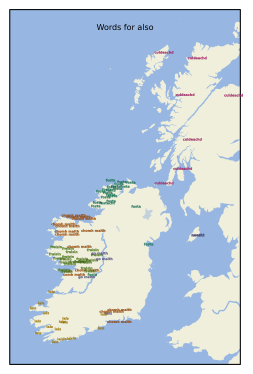

Map 85 in Volume 1 of the LASID shows the word used for "also" at the various survey points. The elicitation prompt was "your shirt is dirty too", with the prior prompt being "my shirt is dirty".
From the plots above, we can see that leis is ubiquitous in Kerry and Cork. We can interpret this as "with it", i.e. "your shirt is dirty with it [it = my shirt]".
Further east in Waterford and Tipperary, chomh maith is more common. This is analagous to English's "as well". One instance of féin is recorded here, with the full utterance being "thá mo léine-se salach féin"1. This is of course more directly translated as reflexive: "my own shirt is dirty". I don't think we should take féin to mean "also" generally.2
We also find chomh maith a little around the border of Clare and Galway, but freisin is overwhelmingly recorded in Conamara. O'Rahilly derives freisin from fa ris sin, which he translates as "moreover"3, but from which the meaning "along with that" can be taken: "your shirt is dirty along with that [that = my shirt]".
As we move further north to Mayo, chomh maith returns, before we reach Ulster, where fosta is almost universally recorded. The two exceptions are the variant fostacht in Ardara, and cuideachd on Rathlin Island, as in the Scottish survey points. Fosta is also found just over the border with Leinster in Omeath, and in one spot in Galway on the border with Clare4. Wiktionary links fosta to fós, meaning "yet, still". I can see how this could become "also", in the sense of an invariant property across compared items. To put it clumsily: "even though we are considering another item, still the property holds".
Returning to the term found on Rathlin and in Scotland: alongside the adverbial usage found in the LASID, cuideachd also means "company", in the sense of companionship, a meaning shared in Ireland5. "Your shirt is dirty in companionship [with my shirt]", perhaps.
On the Isle of Man we find neesht [njɪs], [neːs], which John Rhŷs derives from ina ndís, in Irish orthography, meaning "in their pair"6.
Curiously, go maith is recorded in three places around Roscommon and east Galway. In all three points where go maith was recorded in this way, the Gaelic was all but dead at the time of the LASID. Wagner writes:
of point 26, Careeny:
None of our informants in this mountain area could speak Irish. We were, however, able to collect a few hundred words and little sentences from them. They must have spoken some Irish in their childhood. The area is situated on the Galway/Clare border.
of point 32, Carrowntarriff:
This point represents a place in County Roscommon, about eight miles west of Athlone. Professor T. O Máille (Galway) discovered here two native speakers a few years ago. He recorded answers to our short questionnaire on tape. One of the two informants (a) was very good and could answer most of the questions.
of point 33, Camderry, Galway:
Two fluent Irish speakers were found in this area where Irish must have been alive some twenty years ago. Most of our questions were answered.
Usually, go maith is either the adverb form of "good", i.e. "well", or it is used to express subjective opinion that something is good. Of course, in English we say "as well", and the equivalent expression chomh maith has already been discussed. Is go maith here a corruption of chomh maith? Or a remanant of a lost East Connacht dialectal usage? Searching elsewhere for written attestations of the same usage is made difficult by how common the phrase is in other contexts.
On comparing the LASID results to other sources, we must remember that the LASID does not mean to suggest that no other words could ever be used in an area than those given in the survey. Although freisin is only found in Galway in the LASID data, The Schools Collection, whose material was collected some two decades before the LASID, has some examples elsewhere, though the vast majority are in Galway, followed by approximately a third as many in Mayo7. The obvious geographical clustering observed on the maps does suggest that, even if other terms were in use at the survey points, the ones given in the LASID were likely the most natural for the elicitation.
Comparing some of the complete utterances
Point 1, Ring, Waterford:
,hɑː də ˈl′eːn′ɪʃĕ ˈsᴌɑx xuːˈmɑ,
Thá do léine-se salach chomh maith.
Point 44, Ros Muc, Galway:
tɑː də l′eːn′əsə sɑləx fröʃən̠
Tá do léine-sa salach freisin
Point 70, Glenvar, Fanad, Donegal:
tɑ də l′eːn′əsə sɑ̣lɑ̣ ˈfosṭə
Tá do léine-sa salach fosta.
Appendix I point e, Lewis, Scotland:
hɑ ḍə l′eːnəsə sɑ̣ʟəx kụ̈ḍ′ə̆xḳ
Thá do léine-sa salach cuideachd.
I enjoy seeing commonalities and differences across different parts of Gaeldom:
-
the lenition on tá in the far south of Ireland and the far north of Scotland8
-
the broad s on the emphatic suffix regardless of final consonant, shared across the points in Galway, Donegal, and Scotland, but not by the one in Waterford.
-
the short length of á in both Donegal and Scotland
-
the preservation of the palatalisation of the n in léine in the Irish points, lost in Lewis after the preceding front vowel.
In all examples shown here, I note the lenis slender l in do léine. An earlier question in the LASID reveals that without the possessive adjective, léine starts with a fortis consonant in all but the first point (Ring does not maintain a fortis-lenis contrast on l sounds9). Compare [ʟ′eːn′ĕ] with [l′eːn′ə] at point 44. It is enjoyable to see phonetic evidence of lenition not represented in the orthography10.
-
Occasionally the questionnaire is not followed exactly. In this case this response is listed for prompt 285 ("my shirt is dirty") and translated as "my shirt is dirty too". The response for prompt 286 ("your shirt is dirty too") is blank with a note "cf. 285". ↩
-
If I had been editor of the LASID I would probably have left this off of the map for "also". I am considering removing the word annotation from my digitised version – this is usually what I would do if the phonetic form shown in the map is for a different meaning than the map is meant to represent. Usually Wagner makes a note of this, but not in this case. ↩
-
Ó Maolchonaire, F. (1941). Desiderius, Otherwise Called Sgáthán an Chrábhaidh, by Flaithrí Ó Maolchonaire (Florence Conry) Edited by Thomas F. O’Rahilly, page xxxvi. ↩
-
Of this spot, Lough Attorick, Wager comments: "Only one speaker has survived in this desolate mountain area. He was by no means fluent in Irish." ↩
-
Ó Dónaill's dictionary also defines cuideachta as "company", in the sense of companionship. ↩
-
Broderick, G. (2019). Prof. Sir John Rhŷs in the Isle of Man (1886-1893): Dictionary. Zeitschrift Für Celtische Philologie . https://doi.org/10.1515/ZCPH-2019-0002 ↩
-
Galway has by far the most at 1715, followed by Mayo (625) and Clare (132). We also have Roscommon (32), Cavan (31), Sligo (21), and Kerry (20). Elsewhere there is a smattering (less than ten instances per county). ↩
-
And, I believe, in the rest of Scotland too. ↩
-
Breatnach, R. B. (2009). The Irish of Ring Co. Waterford: a phonetic study. Dublin Institute for Advanced Studies. page 49 ↩
-
Imagine if ⟨l⟩ always represented a fortis variety, whether word-initially or not, and ⟨lh⟩ represented the lenis variety. Similarly for ⟨n⟩ and ⟨r⟩. Maybe I would enjoy the consistency this would bring to the orthography (though this is not a complaint, just a pondering). ↩