 lochsh
Lucky piglets and little hatreds: on Gaelic terms for hedgehog
Fri 11 September 2026Following on from frogject, I am continuing the theme of researching the creatures that live in my garden. This time, the humble hedgehog has his moment in the spotlight. A hogject, if you will.
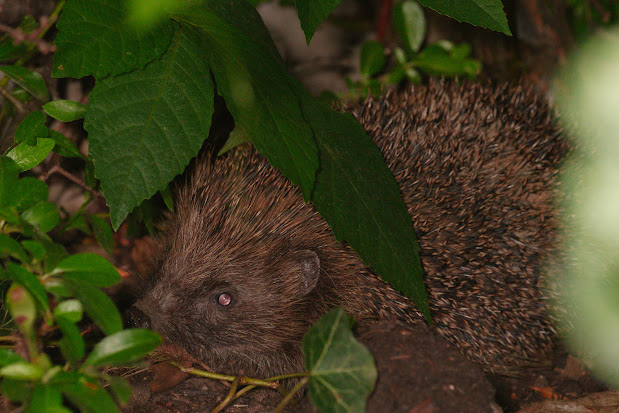
Gráinneog nó gràineag: not so hateful after all?
Near-ubiquitous in the returns for the Linguistic Atlas and Survey of Irish Dialects (LASID) is the word gráinneog. Only two returns in Ireland offer alternative names, which we will address later. Of the seven Scottish survey points, only two give a name for the hedgehog, both variants of this word. The Digital Archive of Scottish Gaelic records usages in Argyll, North and South Uist, Mull, Easter and Wester Ross, and in Cape Breton.
I have commonly seen this word translated literally as "little hatred" or "wee ugly one", given it appears to be formed from gráin ("hatred", "ugliness") and the diminutive suffix -óg1. I personally think of the hedgehog as quite charming; I am delighted whenever I find one in my garden. Such a negative epithet is sad for me to contemplate. Was the hedgehog really looked upon with hatred by Gaels of yore?
In an 1840 article in the Irish Penny Journal2, an anonymous author defends the hedgehog from hateful attitudes (content warning for animal cruelty):
Some twenty years ago it was not unusual in the south of Ireland to see boys assembled about a fire of straw, loudly exulting over a flame-surrounded victim, whose attempts to escape, rendered nugatory by a timid retraction as it were into himself, served but to call forth louder shouts of triumph from his persecutors, who thought they justified their savage deed by proclaiming its hapless object as a witch, a robber of orchards, and a sucker of cows.
Certainly this account would suggest malice towards the hedgehog was widespread.
The charge of stealing milk by suckling sleeping cows is a popular and perplexing one that seems to have been widely believed across these islands3. Similarly puzzling is the image of the hedgehog stealing apples by piercing them on his spines4 – this image remains popular across Europe, seemingly having originated in Pliny's Natural History in the first century AD, but does not seem to be based in reality.
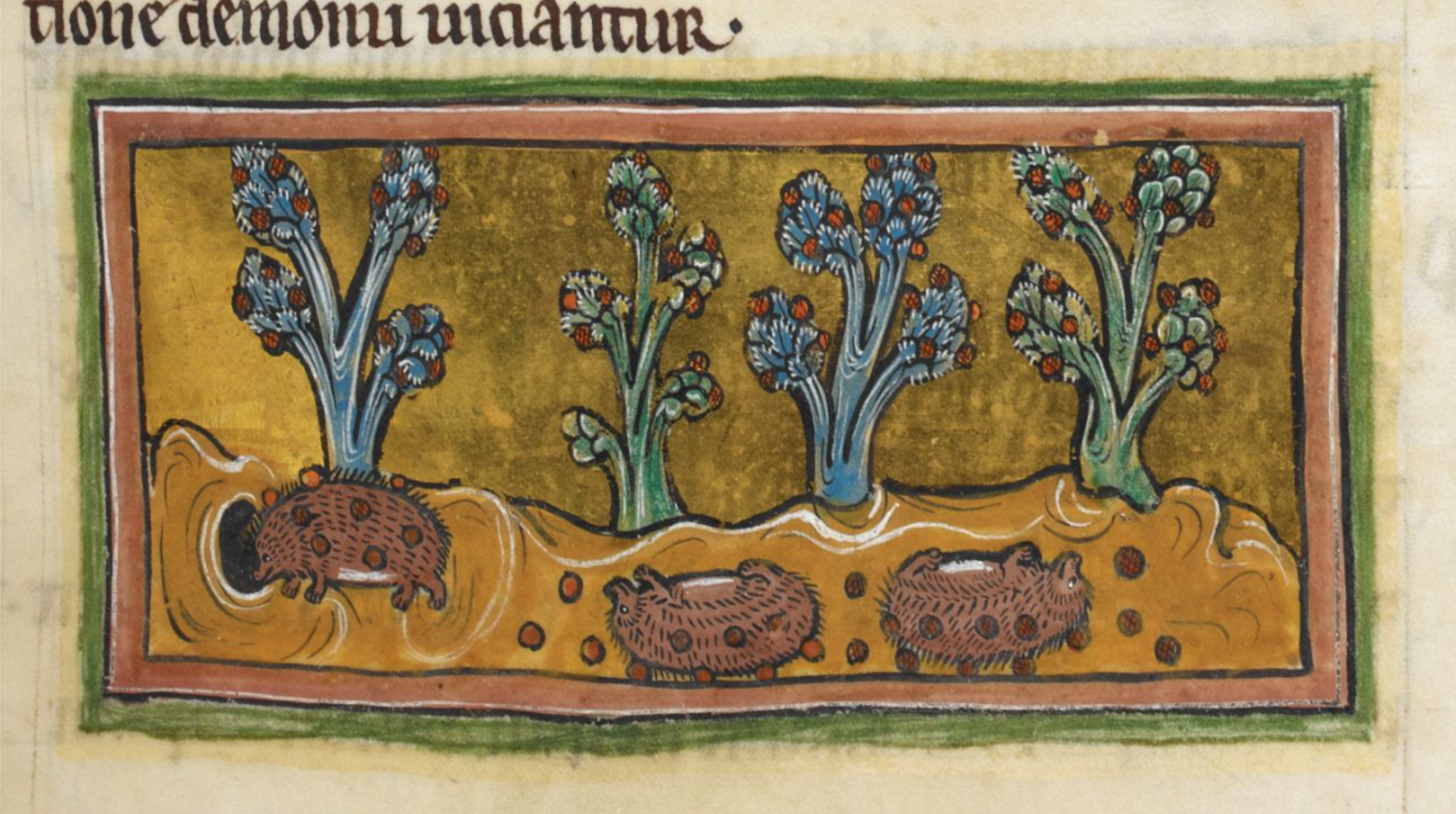
In contrast to these negative notions are a variety of accounts in Ireland of the hedgehog seemingly being considered holy:
Once Our Lord got hungry and the "gráinnóg" taking pity on him went to him and on every one of his thorns grew an apple which he gave to our Lord. He blessed the little animal and ever since it is said it is a sin to kill him.
Deirtear go bhfuil an ghráinneóg beannuighthe mar gur cuimil sí í féin i n-áit a raibh ubhlaí agus gur thug sí ubhall ar gach buir uirthe chuig an Mhaighdean Muire.
[It is said that the hedgehog is blessed because it rubbed itself in a place with apples and brought an apple to the Virgin Mary.]
Might these attitudes better reflect native beliefs about the hedgehog, with animosity being a colonial import? An attractive notion, but not one I can substantiate. The hedgehog is known to suck eggs, after all. It does seem worth noting that from the 1560s to the 1800s, a collection of laws aimed at vermin control, passed by Henry VIII and Elizabeth I, resulted in the mass slaughter of hedgehogs. Atkinson (2009) notes "in Bunbury parish (Ches) in the late seventeenth century, for example, some 8585 were killed in a mere 35 years."
Regardless of the source of animosity, the hedgehog's historical social standing would seem ambiguous, at least in Ireland5. Might we consider that gráinneóg may not be cruelly insulting the humble hog, but instead referring to his spines? Macbain (1911) makes this interpretation, literally translating gràineag as "horrent one". "Horrent" was not a word I had in my personal lexicon; it is derived from the same Latin root as "horror", and has a meaning of bristled, i.e. covered in bristling points. The Latin word for "hedgehog" is related, as shown in the etymology diagram below.
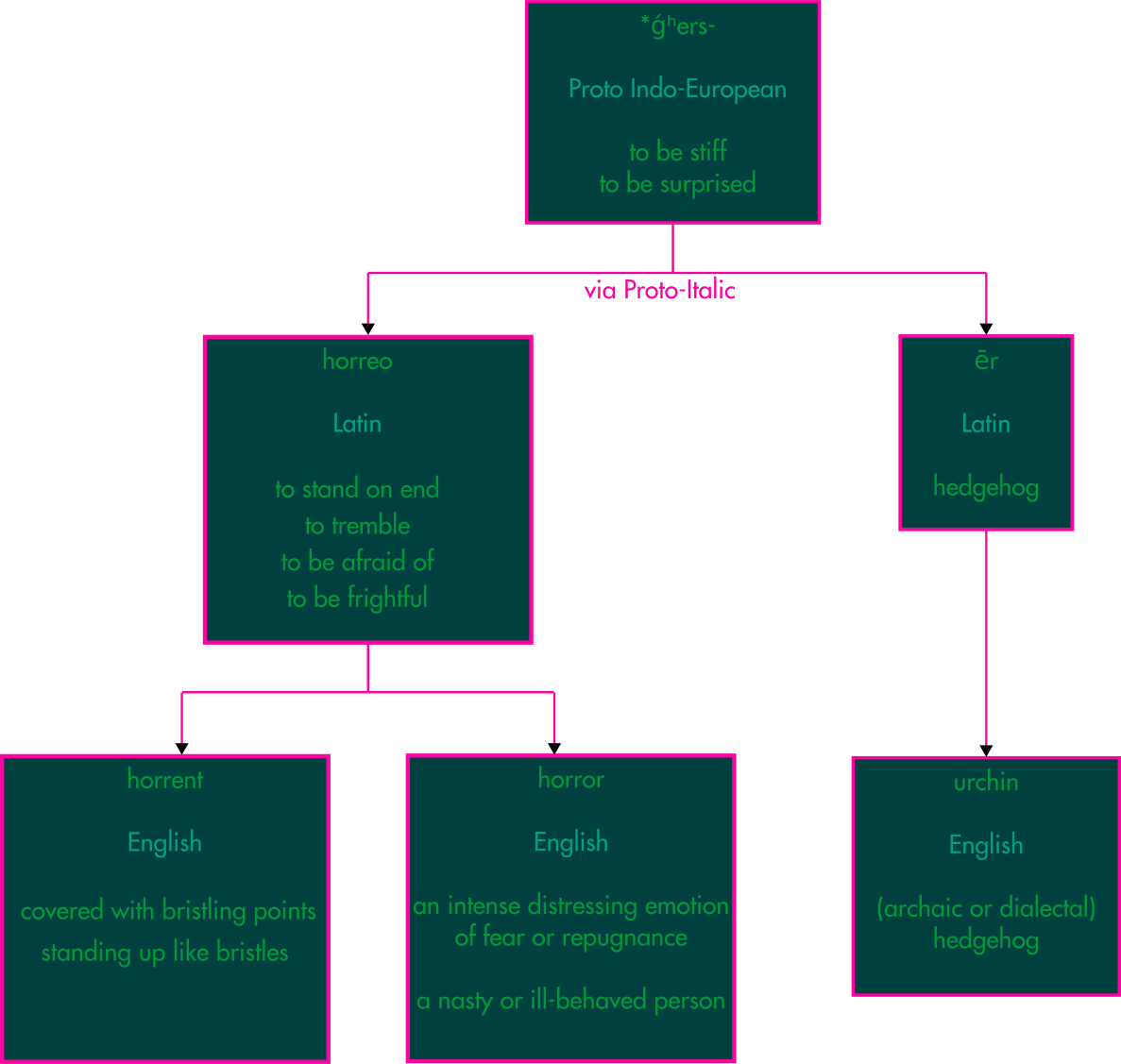
Also derived from Latin horreo are Romanian and Occitan words for "hate".
Beyond analogy to English and Latin, is there any evidence for gráinneóg, seemingly related to a word meaning "hate", being a reference to the hedgehog's spines? A little, but nothing definitive.
Sources across Donegal6 note variants of gráinneóg used for sea urchins. Mac Giolla Easpaig (2025) lists gráinneog from Inis Bó Finne, gráinneog fharraige from Inis Meáin, gráinneog sáile from Ros Goill, and gráinneog uisce from Gaoth Dobhair7. Ó hEochaidh & Ó Catháin (1970) give gráinneog dhearg, for the red colour of the Echinus esculentus. Of course, the term "sea urchin" in English uses a word originally used for hedgehogs. These Gaelic words could also be comparing the sea creature to the hedgehog. However, hedgehogs are thought to have been introduced to Ireland in the 12th or 13th Century8, whereas sea urchins are native. Might we assume that sea urchins would have an older name, not one derived from a later arrival? Perhaps, but there are other names like cuán mara that are in use that could have been supplanted; we stopped calling hedgehogs urchins in English, after all. I will note that it's also common in Donegal to refer to hedgehogs with a qualified noun: gráinneog fhéir, "gráinneog of the grass"9. On the surface this does suggest some shared meaning not specific to the land creature.
Is there any evidence from older language? The Electronic Dictionary of the Irish Language tentatively provides a possible alternative meaning for gráin of "spearpoint". It is used in the In 12th century narrative Acallamh na Senórach, part of the Fenian Cycle:
ocus ni léicfe gráin na sleigi neme codlad fort
agus ní ligfidh gráin na sleá nimhe codladh ort
so shall the point of the spear forbid that sleep fall on thee
Modern Irish translation by Pádraig de Barra
English translation by Standih H. O'Grady. From UCC's Irish Sagas Online
However, you can see how this could perhaps be translated as "the horror/awfulness of the spear" also10.
Another use of the word gráinneog mostly recorded in Connacht is for lapcocks, the first gatherings of cut hay11. My mother recalls the "lapping" in Donegal involving making small piles of hay that had to be turned regularly. Once dried, they were made into stacks. It is not immediately clear how this might be related to the hedgehog – perhaps they were an attractive nest for the creatures, and often found when turning the hay? Did they resemble the creature? LASID point 20 (Dún Chaoin) gives dreas-chocaí for haycocks, seemingly describing the cocks as thorny (from dreas or dris meaning briar or thorny plant). But why they would be thorny is unclear to me. In the end, this agricultural usage has not brought us closer to understanding the word.
We can, however, consider another agricultural topic: grain. The nominative plural of the word grán, meaning "grain", is gráin1213. Might we analyse gráinneóg as comparing the hedgehog's spines to grain seeds? The plural form would make sense, given the hedgehog's many spines. It wouldn't be the only time grán has been used analogously for small spiky things: gráin catha ("battle grains") refers to caltrops, though perhaps because they are thrown to the ground as one might do when sowing seeds14.
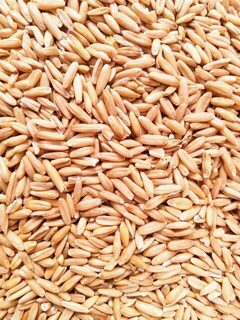
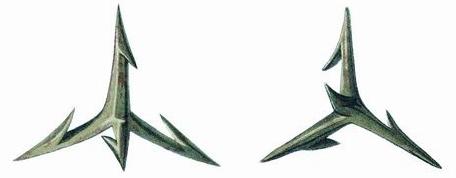

It seems less likely that sea urchins would be compared to grains in this way, however.
Ultimately, the origin of the term gráinneog is unclear, but I personally enjoy the idea of it referring to the hedgehog's spines, whether by comparing them to grains or describing them with a generic word for spikes.
Arkan sonney, arkan vollagh, as muc sonnys
While Ireland and Scotland might appear to espouse hate for the hedgehog with gráinneog, the Isle of Man blesses the hedgehog with the moniker of "lucky piglet". The small table below might elucidate the meanings of these terms by showing them in different orthographies (and grammars, in the case of the last two terms)15:
| Manx | Scottish | Irish | English translation |
|---|---|---|---|
| arkan sonney | uircean sona | arcán sona | happy/lucky piglet |
| arkan vollagh | uircean molach | arcán mollach | shaggy/coarse piglet |
| muc sonnys | muc sonais | muc sonais | pig of good fortune, happiness |
These three terms are taken from Broderick (1984), recorded respectively from an unnammed speaker from the south of the island16, Harry Kelly of Cregneash, and Thomas Christian of Ramsey.
The hedgehog appears to have become synonymous with a creature from folklore, though it is unclear how this association came about. Roeder (1904) describes the "the arkan-sonney, or lucky little pig":
I have heard of some little white animal, like a young pig. They called it the uircean sonny, or the lucky or plentiful little pig. The old people usad [sic] to say if you caught it you would be very fortunate; that you always find a piece of silver in your pocket when you are in need of it. A woman once said that she was walking one night, and came across some little white thing, but she did not catch it, nor try to catch it, but for some time afterwards she always found a. silver piece in her pocket, when she needed it and put her hand into to her pocket not thinking to find it. And this continued for some time; but she told one of her friends about it, and she did not get any more — the bank was closed.
In Gill (1929):
Just above a new house which stands beside the road there is a streamlet inside a gateway, more or less concealed by bushes. Here it was that a boy of twelve who was being driven from Dalby to Peel was delighted by the sight of a strange-looking little white pig wearing a red hat. One of his adult companions remarked to the other in Manx, "that's one of Themselves," and touched up the horse, telling the boy to take no notice of what he had seen; meaning doubtless that he was not to chatter about it, or try to catch it if he should ever see it again. For this was the Arkan Sonney, the little Fairy Pig, an omen of great good fortune, if the seer is content with seeing.
The red hat is a common motif in stories about fairies across Ireland too, though I believe green is/was more common in Scotland and in parts of East Ulster17.
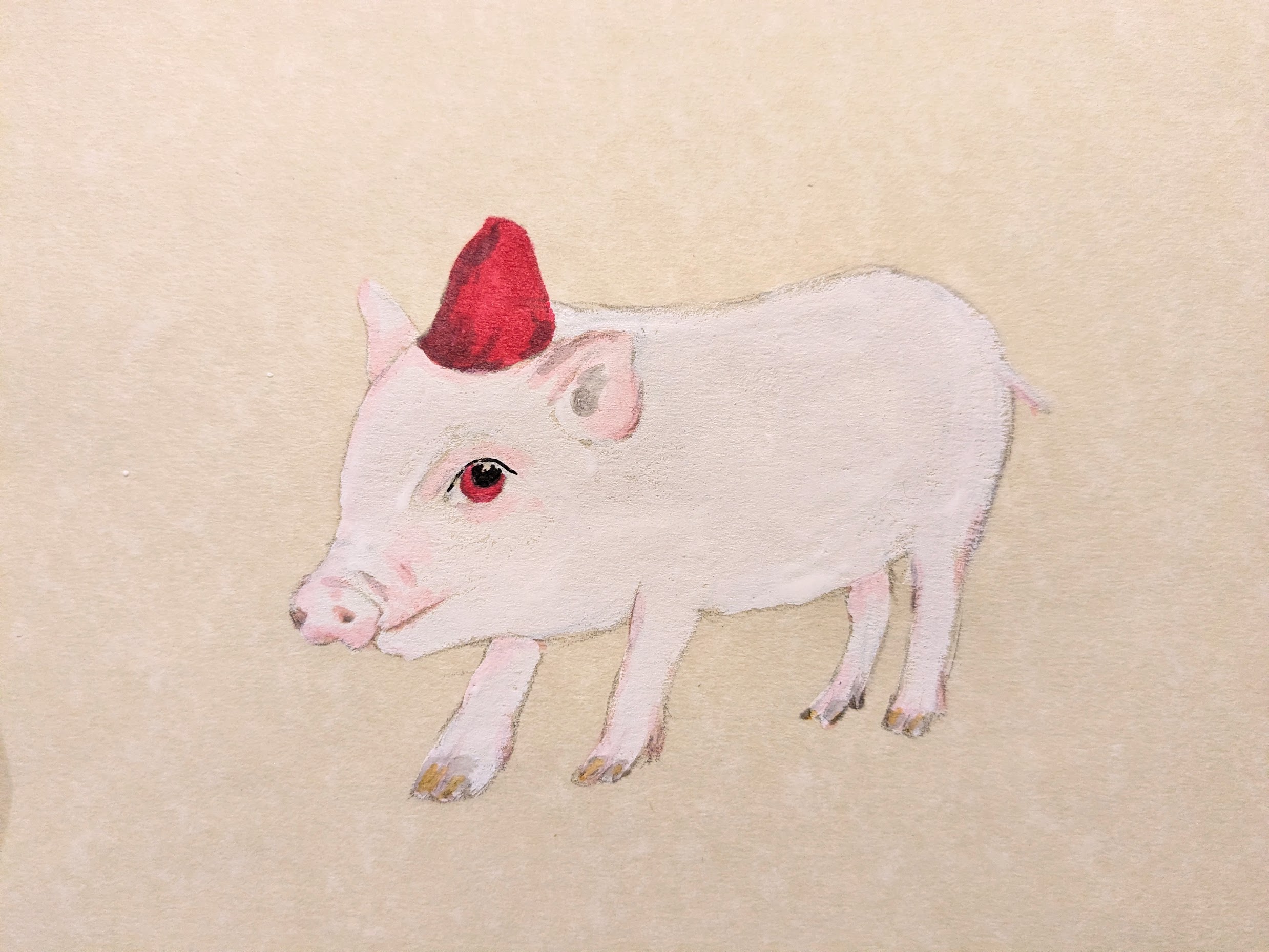
The Isle of Man Times of 7th October 1966 describes the hospital Cronk Ruagh as having a "genuine Manx Arc Sonney, or Lucky Pig, white with red spots, named Jeremy, who collects coins from visitors for the hospital funds". Alas, a photograph is not included – if any Manx (or otherwise) readers are able to provide one, I would love to see the lucky piggybank.
Whilst I could find no similar lore in Ireland or Scotland, the term uircean sona is listed in Forbes (1905). It is not clear if his collection of Gaelic animal names is pan-Gaelic or meant to be specifically collected from his native Scotland – he might have just been listing the term he'd heard used on Man. Uircean sona is also published in a list of Gaelic words for animals in the Oban Times in 1902 but no author is given; it may well be Forbes.
Uircean garraidh...no duircean garraidh?
Continuing the theme of piglets, uircean garraidh, or "garden piglet" is recorded in the Digital Archive of Scottish Gaelic in North Argyll18 and Strathglass.
Also recorded in North Argyll is duircean garraidh. The word duircean (or dearcán) is variously used for acorns, pinecones, thistle-heads. Comparing the hedgehog to pinecones is charming, but I wonder if this might be a mistranscription. As it appears with the definite article, perhaps an t-uircean garraidh might have been what was said? The initial plosive doesn't sound aspirated to me, however, though the recording is noisy.
Púicín or púitín: a mystery
In Ring, County Waterford, the LASID records two words for hedgehog: grɑːˈN′uːg (gráinneóg), and puːˈţ′iːn′. The ţ′ sound is described as being intermediate between t′ and k′, hence I would guess this would be written either púicín or púitín.
I have found no other usage of this word for hedgehog. Púicín has variously been recorded for a blindfold or a game involving one, or similarly a cloth muzzle, a young donkey (because his hair is in his eyes, like a blindfold), a sparrowhawk or kite, a type of opening in a kiln. Púitín is harder to find examples of but is recorded in a few places for a hole in a fence for sheep to pass through, or the opening of a kiln again (though both commonly without the fada on the u). I think it refers to an ant-hill in this riddle with the answer púitín siogháin, spelt púthrín siongán in this example.
None of the above examples bring a hedgehog to mind. Perhaps púicín is a diminutive of púca, and the púca was said to take the hedgehog's shape.
Alp luachra: an error?
Another mystery from the LASID comes from point 31, at Newbridge in Roscommon. Wagner notes "There are only a very few people left in this area who know some Irish. Our informant could not speak it fluently." Perhaps this can explain why the informant gave ,alʰp ˈluəxrə, for the hedgehog, apparently alp luachra. This term usually refers to the newt, believed to crawl down the throats of people who laid down to rest in fields. The newt would then live in the person's stomatch, eating their food, over time causing the victim to waste away. The alp luachra is only drawn out by the victim eating lots of salted meat, to make the alp luachra thirsty, then lying with their mouth open by a river to draw out the thirsty lizards. A bilingual account of this tale can be found in Hyde (1890).
The spiky hedgehog seems less capable of slipping stealthily down someone's throat. But what of the term itself? Luachra means "of the rushes". As a verb, alp can mean "devour, swallow whole"; as a noun, "lump, chunk, knob", or an alternative form of earc meaning "lizard".
I suppose a comparison of a hedgehog's spines to rushes is not preposterous – is it being called a lump of rushes? I still think it more likely that the informant made a mistake.
Rutha
This is a word I have found used for hedgehogs only in dictionary-type sources. Dinneen's 1904 dictionary and Forbes (1905) list it. Dinneen also translates it as "thornback" (Raja clavata), a fish with a thorny tail. It appears to be used in this way in this account from Galway. Clearly the name refers to spikiness, or it would not be shared by these very different creatures. Beyond this, I have no knowledge to offer. That this word (spelt variously) is also used to refer to a piece of land often called a "point" in English seems like a red herring.
Gruin nó griun
Perhaps this is the oldest word listed here. It appears in O'Clery's Glossary of 1643 as griun where it is glossed as gráinéog (fada placement as in the edition linked). The word is also listed in O'Reilly's 1864 Irish dictionary and Shaw's 1780 Scottish dictionary. The only non-dictionary recording I have found is in the DASG's fieldwork archive, in 1967 in Strathglass.
I can't help but notice this word's superficial similarity to gráin. Could gráinneog be related to some older, lost word? I have no justification for the change in vowel, but the prospect is intriguing.
Go rabh maith agat
Go rabh maith agat as léamh mo thaighde. Ma tá aon smaointe agat féin fán foclaí seo, tig leat ríomh-phost a sheoladh ag h@mcla.ug.
Thank you for reading my investigation. If you have any ideas or knowledge about these words, feel free to email me at h@mcla.ug.
Appendices
The hedgehog and the Holy Family
The hedgehog helping Jesus in the desert/when he was hungry:
The hedgehog present at the birth of Christ:
- In Mayo
- In Mayo, same place as above "God was so pleased with the grainneog that He told him to come and live in Heaven with Him. But the grainneog said, 'Is fearr liom mo theachín féin ná aon teach eile.' ['I prefer my own wee house to any other'.] That is why the grainneog has his own (the same) coat always."
The hedgehog bringing apples to Mary:
Hedgehog cures
Boiling hedgehogs and drinking the soup (or eating the flesh) to cure whooping cough
Click to expand
- In Ulster
- In Connacht
- In Galway
- https://www.duchas.ie/ga/cbes/4569068/4568655/4575275
- https://www.duchas.ie/ga/cbes/4569068/4568656/4575280
- https://www.duchas.ie/en/cbes/4569068/4568654/4575273
- https://www.duchas.ie/ga/cbes/4583301/4577775/4586801
- https://www.duchas.ie/en/cbes/4562124/4561501/4571887
- https://www.duchas.ie/en/cbes/4649680/4646117/4650673
- https://www.duchas.ie/ga/cbes/4583273/4575571/4591365
- https://www.duchas.ie/en/cbes/4583273/4575564/4591348
- https://www.duchas.ie/en/cbes/4622999/4622271/4630006
- https://www.duchas.ie/en/cbes/4569055/4567381/4574661
- https://www.duchas.ie/en/cbes/4569052/4567041/4574385
- https://www.duchas.ie/en/cbes/4613673/4607203/4624156
- https://www.duchas.ie/en/cbes/4569049/4566701/4573192
- https://www.duchas.ie/en/cbes/4566057/4563101
- https://www.duchas.ie/en/cbes/4602674/4594369
- In Mayo
- In Roscommon
- In Leitrim
- In Galway
- In Munster
- In Leinster
Cures for toothache involving the hedgehog's jaw or teeth:
Click to expand
- In Connacht
- In Munster
- In Waterford
- In Tipperary
- In Cork
- In Kerry
- In Leinster
The fat of the hedgehog as a cure for deafness
Click to expand
- In Munster
- In Leinster
Cures involving hedgehog spines
Click to expand
- In Ulster
- In Connacht
- In Leinster
The hedgehog coming out of his hole on St Bridget's Day
This is tradition travelled from Europe to America where it has become known as Groundhog Day.
- In Mayo, St Bridget's Day
- In Mayo, St Bridget's Day, same place as above
- In Mayo, St Bridget's Day, same place as above
- In Mayo, "about February 2nd"
- In Longford, no specific day
- In Carlow, Valentine's Day
Riddles in which the hedgehog's coat is described as Albanach or Sasanach
Bibliography
-
Atkinson, R. (2009). Silent Fields: The Long Decline of a Nation’s Wildlife. Oxford University Press.
-
B. (1840). An Ghraineog / The Hedgehog. The Irish Penny Journal, 1(21), 166–167. https://doi.org/10.2307/30001176
-
Borsje, J. (1994). The Bruch in the Irish Version of the Sunday Letter. Ériu, 45, 83–98. http://www.jstor.org/stable/30007713
-
Broderick, G. (1984). A Handbook of Late Spoken Manx: Vol. 2, Dictionary. Buchreihe der Zeitschrift für celtische Philologie
-
Forbes, A. R. (1905). Gaelic names of beasts (Mammalia), birds, fishes, insects, reptiles, etc.. Edinburgh : Oliver and Boyd : Norman Macleod.
-
Forvague, S. (1767). A New Catalogue of Vulgar Errors.
-
Gannon, P. (Ed.) (1999). The Way It Was. Galway.
-
Gill, W. W. (1929). A Manx Scrapbook. Bristol : J. W. Arrowsmith Ltd. [Online edition]
-
Haigh, A., Butler, F., & O’Riordan, R. M. (2012). Habitat use by the European hedgehog (Erinaceus europaeus L., 1758) in an Irish rural landscape. The Irish Naturalists’ Journal, 36–45. http://www.jstor.org/stable/24394186
-
Hyde, D. (ed. & trans.) (1890). Beside the Fire: A Collection of Irish Gaelic Folk Stories. David Nutt : London.
-
Macbain, Alexander (1911). An Etymylogical Dictionary of the Gaelic Language. Stirling : Eneas Mackay.
-
Mac Giolla Chearna, P. (1940). Ceachta as Leabhar na Cruinne. Baile Átha Cliath : Oifig an tSoláthair.
-
Mac Giolla Easpaig, Cormac (2025). Fá Bhruach an Chladaigh. Donegal : Éabhlóid.
-
Montgomery et. al. (2014). Origin of British and Irish mammals: disparate post-glacial colonisation and species introductions. Quaternary Science Reviews, Vol. 98, 144-165
-
Ó hEochaidh, Seán & Ó Catháin, Séamas (1970). Foclóir agus Seanchas na Farraige. Zeitschrift für celtische Philologie, 31, 256
-
Roeder, K. (1904). Manx Notes and Queries. Douglas : S.K. Broadbent & Co. Ltd. [Online edition]
-
Watson, S. (2003). Saoghal Bana-Mharaiche: Oral Accounts of Life in an Easter Ross Fisher Community (Part 1). Béaloideas, 71, 75–215. https://doi.org/10.2307/20520826
-
It's common for compound words to have the fada dropped in óg – I'm not sure why, as in Donegal I wouldn't expect it to make any difference to pronunciation, and further south I would expect to hear a clear, possibly long vowel regardless. I haven't paid much attention to whether I have included it in the spellings here or not, and I don't feel the need to be consistent. ↩
-
B. (1840) ↩
-
I am not alone in questioning the anatomical feasibility of hedgehogs suckling cow's udders. In Forvague (1767):
But a Hedge-Hog has no such Mouth, as to be able to contain the Teat of a Cow; therefore any Vacuum, which is caused in it's own Throat, cannot be communicated to the Milk in the Dug. And if he is able to procure no other Food, but what he can get by sucking Cows in the Night, there is likely to be a Vacuum in his Stomach too.
Nevertheless, the idea was still persistent almost two centuries later. Despite a 1908 declaration by the British government's Board of Agriculture and Fisheries that the idea of hedgehogs suckling cows has no basis in fact, various later news articles report sightings of hedgehogs at the suckling. A number of sources in Ireland's National Folklore Collection mention this belief also. TODO: list sources. A letter in the Western Morning News in 1938 gives a seemingly reasonable explanation for the origin of this curious notion:what does happen often, no doubt, is that "piggie" discovers a cow with milk running from her udder, and he settles down to lick it as it flows; but in doing so he is not robbing the cow, but only utilizing what would otherwise be wasted!
↩ -
Borsje (1994) notes the similar images in the Ulster Cycle. In a description of Cú Chulainn in Táin Bó Cúailnge, translated by Cecile O'Rahilly:
His hair curled about his head like branches of red hawthorn used to re-fence a gap in a hedge. If a noble apple-tree weighed down with fruit had been shaken about his hair, scarcely one apple would have reached the ground through it, but an apple would have stayed impaled on each separate hair because of the fierce bristling of his hair above his head.
↩ -
There is some suggestion that hedgehogs were looked upon kindly in Scotland in this account from Forbes (1905):
In some parts of the North the name of the hedgehog was given to a very mysterious animal which, when met with among the corn, had only the appearance of a grey stone, but could change its shape. When thus met with a small quantity of the crop was left standing around it, and only the ears of grain cut. Such a clump has been seen by the compiler, and the above given him as the reason. It was called "Tom an ioghnaidh," the wonder clump or tuft ; as few knew, every one almost wondered why it existed.
To leave the creature undisturbed during the harvest shows care for its wellbeing. Forbes also records a superstition in Advie in Strathspey of it being unlucky to meet a hedgehog, particularly after nightfall. The hedgehog wasn't introduced to many Hebridean islands until the late 20th century. ↩ -
I couldn't find any uses of gráinneóg on duchas.ie that clearly referred to sea urchins. Other terms are in use and perhaps more popular. I couldn't find any sources in Scotland using the word for sea urchins beyond this dictionary entry, though it does not appear in Dwelly's dictionary so I'm not sure where it's sourced from. ↩
-
gráinneog fharraige = gráinneog of the sea; gráinneog sáile = gráinneog of the sea [water]; gráinneog uisce = gráinneog of the water ↩
-
Montgomery et. al. (2014) and Haigh & O'Riordan (2012) ↩
-
LASID points 71, 74a, 75, 77, 78, 80-86, 86a; a variety of sources in The Schools' Collection; Mac Giolla Cearna (1940) p. 96. LASID point 67 (Rathlin Island) also records this. I will note that gráineog fhéir has also been recorded, e.g. in Dinneen's dictionary (with a note saying it was recorded in Donegal), as referring to a lapcock of hay. More on this above. ↩
-
The other example given in the eDIL is from a Middle Irish grammatical tract and has a compound gráindealgaigh, from dealg, meaning prickle, thorn, skewer. However, I do not understand the rest of the sentence. ↩
-
Recorded in Gannon (1999); LASID points 54 (Acaill) and 55 (Dumha Thuama). Also listed on this website dedicated to the Irish language in County Mayo. Dinneen also lists gráineog fhéir for the same meaning, but gives Donegal as the place it was recorded.
Beyond my mother's, I have seen various descriptions of how lapcocks are made. Some describe "a method of rolling the hay in batches and setting on dry bits of ground with the least amount of hay touching the ground as possible", and varyingly are described as being "rolled up in such a way as to form conical heaps" or "when well made, [having] the appearance of a round ball, flattened a little beneath". Last two descriptions taken from and sources in the Dictionaries of the Scots Lanauge page on "lap". ↩ -
Modern dictionaries say this word has no plural but it is attested. ↩
-
gràineag has also been used in Scotland to mean small amount, see the usage in Watson (2003): "'nam bitheadh poc agam dhèanainn gràineag guail", translated as "if I had a bag I'd get myself a good bit of coal". It is also listed in Dwelly's dictionary as meaning "small grain", which makes sense to me, though the slenderisation of the "n" is curious. I think this easily could have evolved from gràn alongside the word referring to hedgehog, so I'm not sure it really provides any evidence towards the etymology for the word for hedgehog. It might explain the usage for haycocks, if their defining characteristic was being a small amount, particularly if the same process was used when harvesting grains. ↩
-
I did consider whether gráin catha was referring to the spikes, rather than comparing to grains, but I'd expect a different plural form like gráineacha perhaps. ↩
-
From Broderick (1984): "The genitive singular case with a separate form has largely disappeared in Late Spoken Manx. Nouns in a genitival relationship with another noun, with or without the definite article or possessive adjective, usually appear in the same form as the general[...]". Revived Manx would have a morphological genitive case in muc sonnys. As for the lenition on arkan vollagh, Broderick writes: "The system of gender in Late Spoken Manx has more or less broken down from its more Classical forms of masculine and feminine." ↩
-
Arkan sonney was recorded by Wagner and reproduced in Broderick's thesis. This is also published in Wagner's LASID, where he lists the speakers from the South as Eleanor Karran of Cregneish, Ned Madrell of Glenchass, and Mrs Watterson of Colby. ↩
-
I have read about this in Ulster Folklore by Elizabeth Andrews (1913). ↩
-
I expect the speaker is this Alasdair Cameron, from Strontian, which used to be part of Argyll. ↩